
NTT at Ten: Expanding the Theatre Beyond the Stage
NTT at Ten: Expanding the Theatre Beyond the Stage
In its tenth year of operation, the National Taichung Theater (NTT) has moved beyond the definition of a performing arts venue. Rather than functioning solely as a destination for ticketed performances, the theatre has spent the past decade cultivating a network of non-traditional spaces – places where architecture becomes an active participant in artistic creation, visitors, audience, and arts practitioners all blend into a dynamic community, and where cultural experiences unfold as part of everyday life.
Across these spaces, programming ranges from experimental performances and audiovisual installations to outdoor cinema and participatory public art, welcoming not along core theatre audiences but also families, young people, and first-time visitors. Regardless of age or background, audiences can discover their own pathways into the arts, positioning the NTT as a civic environment where art and culture are seamlessly integrated into daily life – ensuring that every visit holds the promise of the unexpected.
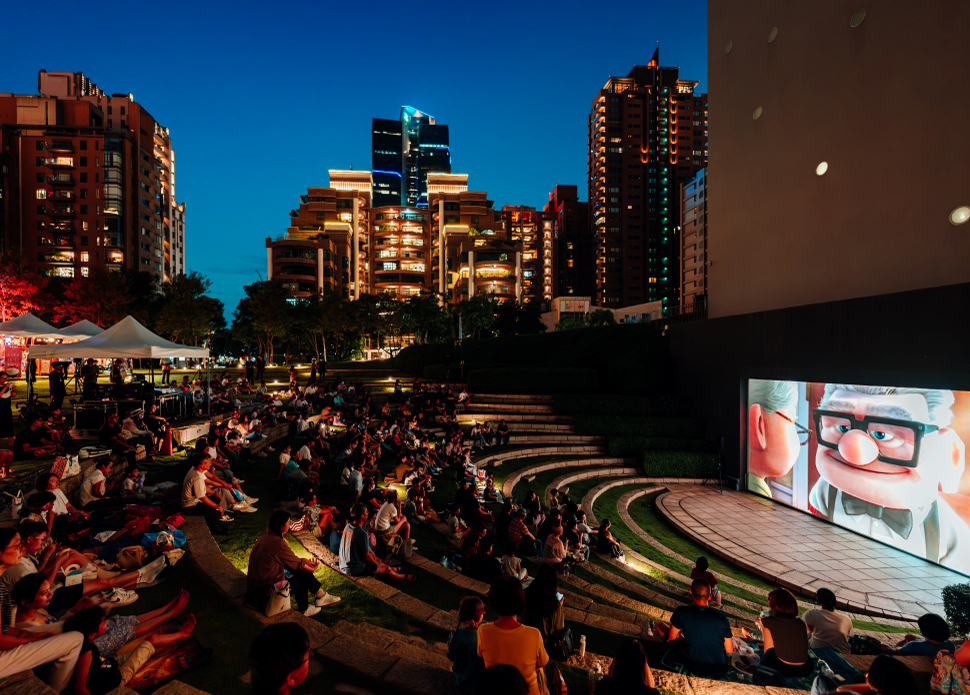
The Outdoor Theater has been activated through Movie Night Out. (Photo credit: CHEN Jian-hao)
The Outdoor Theater: Cinema as a Shared Urban Experience
Located on the theatre’s lower level, the Outdoor Theater is one of the NTT’s most flexible performance spaces. While the indoor venue accommodates 200 seats, its signature retractable door allows the space to open outward, transforming into a 1,000-square-meter Roman-style amphitheater. This seamless connection between interior and exterior dissolves the traditional boundary between stage, audience, and garden.
The space has been activated through Movie Night Out, a carefully curated outdoor cinema programme that treats film as a shared cultural encounter. Rather than casual screenings, the programme features family-friendly films, documentaries, and classics by master filmmakers, guiding audiences to engage with cinema from diverse perspectives. Each programme attracts different communities — from families and students to cinephiles and members of public — many of whom may not initially come to the theatre for a performance.
On clear evenings, films are projected onto the theatre’s surfaces as city breezes pass through the open space, turning an ordinary weeknight into a collective urban memory shaped equally by architecture and cinema.
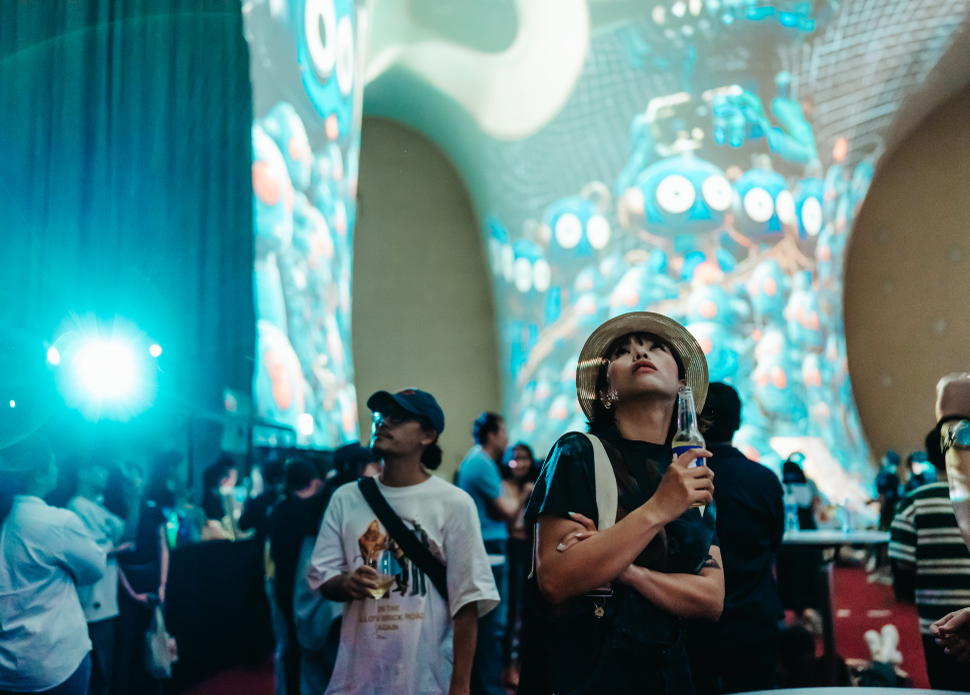
The Grand Theater lobby, through the T.A.P. Project, has been transformed from a transitional foyer into a site of artistic creation. (Photo credit: LIN Chun-yung)
The Grand Theater Lobby: Architecture as an Audiovisual Canvas
The Grand Theater lobby — defined by its soaring 19-meter curved wall — has been transformed through the T.A.P. Project (Technology × Art × Public) from a transitional foyer into a site of artistic creation. Through invited commissions and open calls, local and international audiovisual artists are encouraged to respond directly to the architecture scale, curvature, and material presence.
Light, sound, and digital imagery unfold across the monumental wall, turning the lobby into an immersive environment that shifts with movement and perspective. Visitors get to experience large-scale audiovisual works not within a black box, but in the everyday threshold of the theatre. Since its launch in 2020, the T.A.P. Project has attracted over 800,000 visitors, revealing a strong public appetite for experiences that blur the boundaries between art, architecture, and daily life.
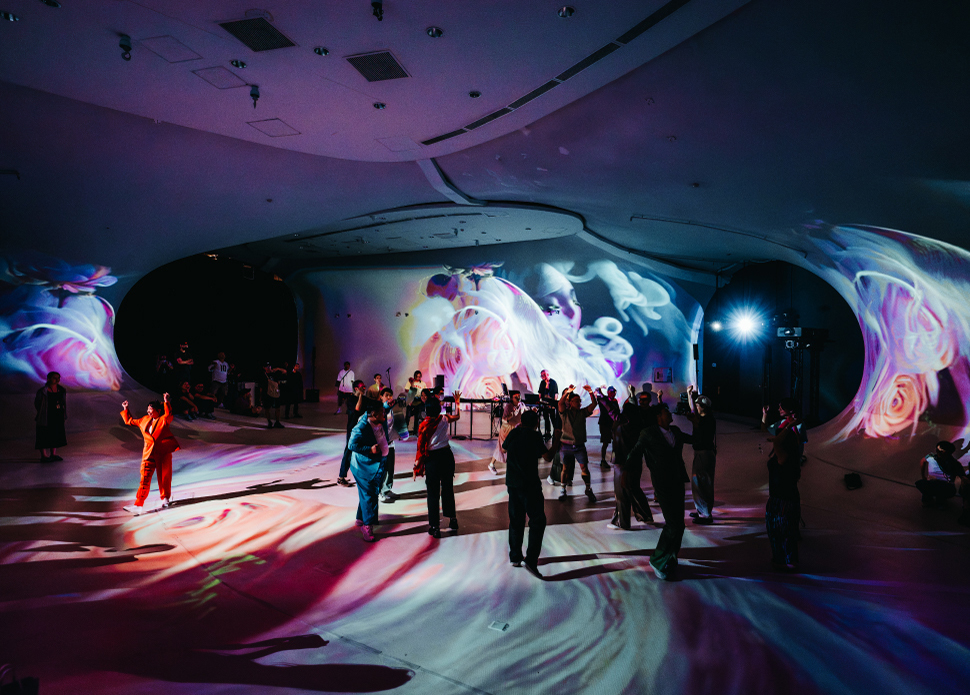
Reverberation of Illusions. The Tutu Gallery embodies artistic freedom shaped by architecture rather than constrained by it. (Photo credit: LIN Chun-yung)
Tutu Gallery: A Curved Utopia for Artistic Freedom
Conceived in Toyo Ito’s original design as an open-ended creative space, the Tutu Gallery embodies artistic freedom shaped by architecture rather than constrained by it. Tucked within the theatre’s interior circulation, its continuous curved walls unfold like fabric, bathing the space in sculpted light and subtle acoustics. The gallery was envisioned as a place for creators who resist conventional stages and formats.
This vision is realised through immersive, interdisciplinary works that treat the space itself as a collaborator. In Reverberation of Illusions, the late artist YEH Ting-hao and musician CHENG Ke-chun transform the gallery into both stage and instrument: curved surfaces generate lingering echoes, while real-time audio analysis drives responsive projections that pulse with the music. Spectators are enveloped in a dialogue between sound, light, and architecture — an experience inseparable from the space in which it unfolds.
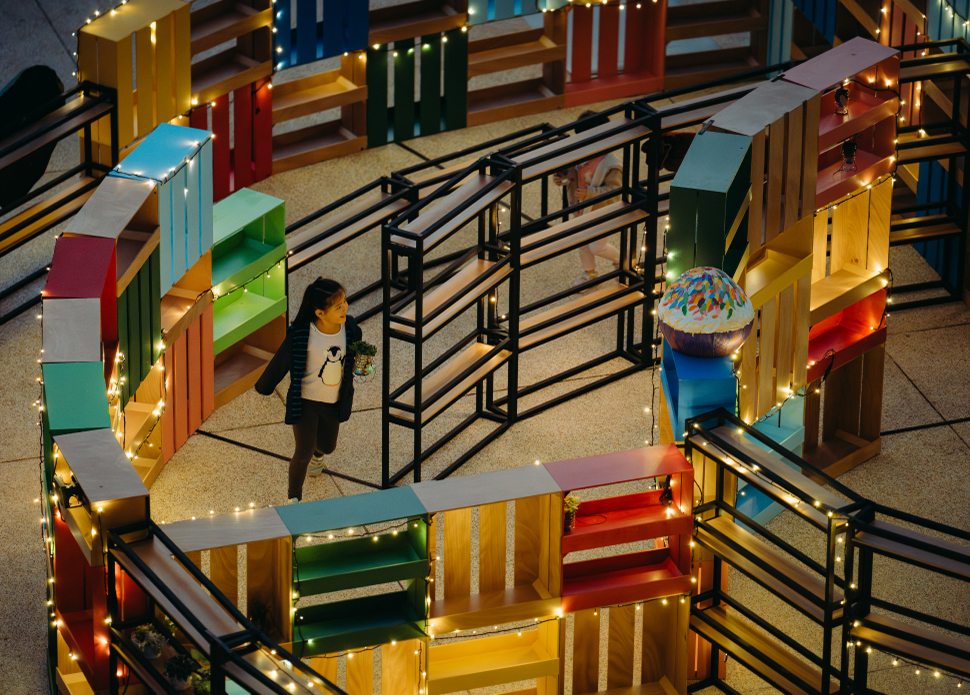
The NTT presents a project, The Living Maze, that reflects its long-term commitment to sustainability. (Photo credit: YE Wei-chen)
Sky Garden: A Seasonal Retreat Shaped by Public Participation
Perched on the rooftop, the Sky Garden is a beloved urban retreat where visitors pause, gather, and reconnect with the city. Each year-end holiday season, the public eagerly anticipates the NTT’s festive installation, and in the tenth anniversary year, the NTT presents a project, The Living Maze, that reflects its long-term commitment to sustainability. For this installation, the rooftop is transformed into an interactive, living landscape shaped through collective participation. Visitors are encouraged to arrive by public transport, on foot, or by bicycle, and to actively contribute to the evolution of the artwork. In this elevated setting, environmental responsibility, everyday leisure, and cultural experience converge above the city.
A Theatre That Breathes with the City
Over the past decade, the NTT has demonstrated how architecture, performances, exhibitions, programming, and public engagement work together to redefine what a theater can be. Echoing Toyo Ito’s architectural concept to create an open structure akin to nature, allowing light, air, water, and sounds to flow freely, the General and Artistic Director Joyce CHIOU and the team have further proved that something as essential as sunlight, air, and water, the NTT has become woven into the city’s rhythm. Looking ahead, the theatre continues to build a legacy shaped by experimentation, accessibility, and sustainability, offering a model for how the performing arts can meaningfully inhabit contemporary urban life.