
Adelaide Symphony Orchestra launches the Miriam Hyde Circle
Adelaide Symphony Orchestra (ASO)’s Board Chair Kate Gould announced the launch of The Miriam Hyde Circle, an exciting new ASO initiative, committed to greater representation of female composers – past, present and future – on the stage.
Kate says, “A trailblazing South Australian, Miriam Hyde AO OBE (1913-2005) was one of Australia’s foremost pianists, composers and music educators of the twentieth century. A graduate of the Elder Conservatorium of Music, she also attended the Royal College of Music in London and, in addition to her orchestral music, composed over150 works for piano and 50 songs.
“It is also a great honour to announce that the inaugural chair of The Miriam Hyde Circle is another distinguished South Australian, the Hon. Catherine Branson AC QC.”
The ASO recognises the importance of female composers. The circle is part of the ASO’s inclusive cultural agenda and will celebrate the significant contributions made by women in music while supporting the future of Australian and international female composers.
During ASO’s 2021 Symphony Series, each concert will feature at least one work by a female composer, and Miriam Hyde’s Adelaide Overture will be performed at Symphony Series 3 in July. Miriam Hyde was in her early 20s and not long back from her studies in London when, in 1936, she created this spirited overture to honour the centenary of the founding of Adelaide – a heart-warming musical celebration of home.
The Hon Catherine Branson AC QC is the inaugural chair of the Miriam Hyde Circle. She says, “The Adelaide Symphony Orchestra has a commitment to shining a light on women composers of the past and present, as well as commissioning new works by living female composers. A former student and teacher at the University of Adelaide’s Elder Conservatorium, Miriam Hyde AO OBE was a brilliant composer with a lifelong dedication to teaching. We are delighted that her family has agreed to our naming the giving circle in her honour. Please join me in this exciting new initiative that brings together like-minded donors to support the ASO’s ambitions.”
Dr Miriam Hyde AO OBE, AMUA, LAB, MusBac (Hons), ARCM, LRAM, HonDLitt, HonFMusA, HonFIMT, FCompASMC, HonDipMus, (1913-2005) was one of Australia’s foremost pianists, composers and music educators of the twentieth century. Born in Adelaide, she attended the Elder Conservatorium of Music and the Royal College of Music in London. In 1981 she was made an Officer of the Order of the British Empire (OBE) and in 1991 was made an Officer of the Order of Australia (AO). She was awarded an honorary doctorate by Macquarie University in 1993, and in 2004 received an award for Distinguished Services to Australian Music at the Australasian Performing Right Association and Australian Music Centre Classical Music Awards.
Miriam’s love and passion for music was profound. She said, “I feel my music can be a refuge for what beauty and peace can still be omnipresent…the triumph of good over evil. I make no apologies for writing from the heart”.
After her 79th birthday in 1992, she wrote a poignant poem about her dedication to music making:
God showed me that my life was meant
For Music’s service; and in this
I have found harmony and bliss,
And opportunities to share
The mystic passage through the air
Of sounds, in Nature, sounds designed
By virtue of the human mind.
How much or little time that I
May have on earth before I die,
I pray my work will be finished be, –
A unit in Eternity.
Miriam’s daughter Christine is thrilled that her mother will be recognised through the naming of the giving circle; she says, “Mum was such a passionate advocate for music education, and to be honoured with the tile of the Miriam Hyde Circle is a great gift. I know she would be excited that the ASO is committed to celebrating the significant contribution of female composers and highlighting the diversity of talent and creativity of female composers through history to the present day.
”She would have been surprised and honoured. She was incurably modest and quiet in her achievements, and always conscious of her Adelaide roots.”
Having to select which of her mother’s compositions is her favourite is difficult, but she says, “The major work that stuns me every time I listen to it is her first Piano Concerto. The sheer exuberance and energy and joie-de-vivre bring me to tears every time. I think it reflects her excitement at living in the great city of London, the privilege and stimulus of her musical environment at the Royal College of Music. For a 19-year-old girl from the small city of Adelaide to conceive the orchestration was a quantum leap from anything she had written before then. The thrill of performing it with the London Philharmonic Orchestra, must have been one of the greatest experiences in her life.”
ASO Managing Director Vincent Ciccarello says, “With all too rare exceptions, accomplished musical women have been overlooked for centuries, missing out on the opportunities and recognition they deserved. The Miriam Hyde Circle aims to change that by celebrating women composers of the past, present and future. The ASO is thrilled to be able to play a small part in this revolution. I urge you to consider joining this special group, named in honour of a pioneering South Australian, to support and nurture the music of women composers.”
Miriam Hyde Circle membership
An individual can become a member for a minimum of one year, joining a vibrant community committed to supporting the performance of works by female composers throughout history and the commissioning of new work by female composers.
Memberships can be started anytime throughout the year, and monthly payment options can be arranged by contacting ASO’s Senior Manager Development, Annemarie Kohn, kohna@aso.com.au.
Miriam Hyde Circle Members are recognised on the Adelaide Symphony Orchestra website and in concert programs.
The Miriam Hyde Circle logo was designed by ASO Graphic Designer Georgie Phillips, who says, “The logo explores the idea of balance, as we endeavour to tip the scales towards female composers receiving the same recognition as their male counterparts. The design also references organic elements, reflecting Miriam’s affinity for writing about the natural environment.”
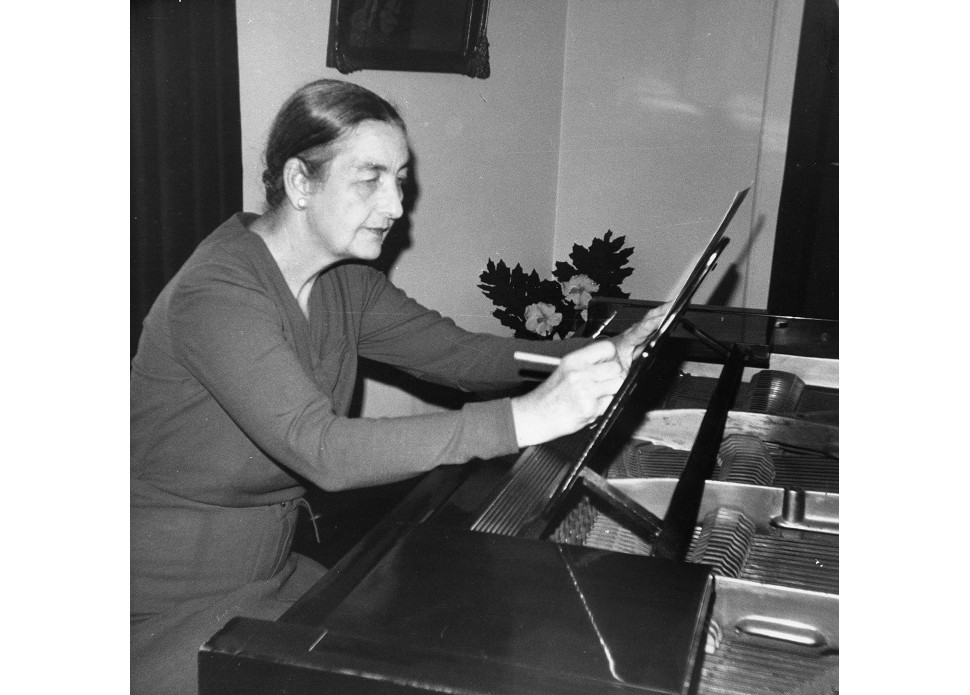
Miriam Hyde
Miriam Hyde Biography
Miriam Hyde was an Australian composer (mainly classical), pianist, music educator and poet. She composed over 150 works for piano, 50 songs, and other instrumental and orchestral works, and performed as a concert pianist with eminent conductors including Sir Malcolm Sargent, Constant Lambert, Georg Schnéevoigt, Sir Bernard Heinze and Geoffrey Simon.
Miriam Hyde was born in 1913 in Adelaide. She studied first with her mother, and then with William Silver after winning a scholarship to the Elder Conservatorium of Music. After receiving the University’s Diploma (AMUA) and winning the South Australian prize in 1928, she graduated with a Bachelor of Music in 1931 and won the Elder Scholarship to the Royal College of Music, London which she attended from 1932-35. During her three years there, her professors were Howard Hadley and Arthur Benjamin (piano), and R O Morris and Gordon Jacob (composition). She won three composition prizes and was soloist in her two piano concerti with the major London orchestras, including the BBC. She also made broadcasts, on what was then called “short wave”, to countries of the existing Empire, including Australia.
Returning to Adelaide in South Australia’s centenary year, 1936, Hyde wrote much of the orchestral music for the pageant Heritage, produced in the Tivoli Theatre. Of this music her Fantasia on Waltzing Matilda, an overture to one of the scenes, has become well known as an independent piece in her various arrangements of it. Also in that year, her Adelaide Overture was first performed and conducted by (then Dr) Malcolm Sargent.
Seeking the wider scope of Sydney, she taught for several years at Kambala School and lived in Sydney for most of the remainder of her life, active as composer, recitalist, teacher, examiner, lecturer and writer of numerous articles for music journals. For a period during the War, however, when her husband, Marcus Edwards, was a POW in Germany, she returned to Adelaide and taught piano and musical perception at the Conservatorium. It was during that stressful time that she wrote her dramatic Piano Sonata in G minor.
Hyde’s works include many for piano, from Preliminary to Diploma standards, more than fifty songs (several of which, set to her own poems, have won prizes, e.g. Elfin Fantasy, Winter Willow Music, Sunrise by the Sea), chamber music, sonatas for viola, clarinet and flute, four overtures, and other orchestral works. Her Happy Occasion Overture was performed in the inaugural concert of the Australian Youth Orchestra at the Sydney Town Hall in 1957.
She performed with all the major Australian orchestras (except Brisbane), and with conductors of eminence, including Sir Malcolm Sargent, Constant Lambert, Georg Schnéevoigt, Sir Bernard Heinze, Dr Edgar Bainton, Joseph Post, and Geoffrey Simon (with whom, in 1975, she recorded her two piano concerti with the ABC’s West Australian Symphony Orchestra).
Miriam Hyde was Patron of the Music Teachers’ Associations of NSW and SA, and also of the Blue Mountains Eisteddfod and the Australian Musicians’ Academy. She was Honorary Life Member of the Fellowship of Australian Composers, the Victorian Music Teachers’ Association, and the Strathfield Symphony Orchestra (with whom, in April 1996, she played the solo part of her Fantasy Romantic for the first time since 1963, when she had performed it during an Australasian Composers’ Seminar in Hobart).
During the 1990s Hyde recorded two CDs of her own piano works, for the National Anthology (CSM No 16) and Southern Cross (No 1027). The ABC, in 1996, produced a CD of her two concerti and the orchestral work Village Fair. Her Clarinet Sonata is included on a CD on the Tall Poppies label, and the Macquarie Trio has recorded for the ABC her Fantasy Trio. Her 1992 piece Valley of Rocks has become her best-known piano work since its exposure in the 1988 Sydney International Piano Competition, in which it was by far the favourite choice among the seven Australian works submitted.
Miriam Hyde’s special awards included the OBE (1981), AO (1991), International Woman of the Year (1991-92) for service to music (bestowed by the International Biographical Centre, Cambridge), and HonFMusA (1995). She was awarded an honorary doctorate by Macquarie University in 1993.
In 2002 Hyde accepted the Award for Long-Term Contribution to the Advancement of Australian Music at the APRA/Australian Music Centre Classical Awards. The award preceded Hyde’s 90th birthday celebrations in 2003, which included a concert of her works presented at Eugene Goossens Hall in Sydney. Miriam received a further APRA/Australian Music Centre Award in 2004, the Special Award for Distinguished Services to Australian Music.
Miriam Hyde AO, OBE died in January 2005, a few days short of her 92nd birthday.
COME AND CREATE A SPACE FOR MUSIC
The Adelaide Symphony Orchestra is for all South Australians.
ASO believes everyone should have the chance to experience orchestral music. We aim to reach as many people as possible each year through a diverse programme across many genres and formats, and perform at venues right across the State and beyond.
Adelaide Symphony Orchestra is South Australia’s largest performing arts organisation. Established in 1936, it has been bringing music into the lives of South Australians for 84 years. As well as presenting orchestral concerts, the ASO’s focus is on nurturing our future musicians and audiences through concerts, education and community programs. ASO aims to inspire, challenge, educate and entertain.
MEDIA ENQUIRIES:
Cheree McEwin, Publicist, Adelaide Symphony Orchestra
mcewinc@aso.com.au