
Five Minutes with the World Federation of International Music Competitions
Get to know the World Federation of International Music Competitions (WFIMC), one of our newest AAPPAC Business Circle Members through its Secretary-General Florian Riem!
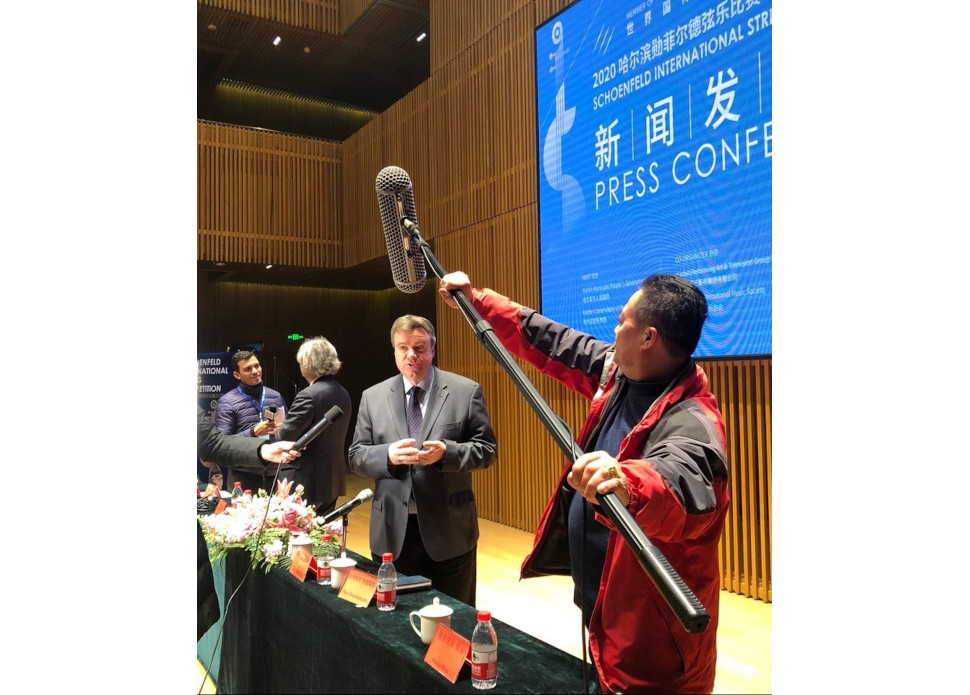
Secretary-General Florian Riem at the press conference of the Schoenfeld International String Competition in Harbin, China (January 2020)
WFIMC is comprised of over 110 international music competitions and other institutions dedicated to identifying the most promising young talents in music! Tell us a little bit more about the work of the Federation and how the network operates.
Based in Geneva, Switzerland, the World Federation of International Music Competitions (WFIMC) is a member of the International Music Council of UNESCO in Paris. Founded in 1957, it is a global network of the top music competitions in the world, including some household names such as the Tchaikovsky, Cliburn, Chopin, Sibelius, Long Thibaud, Paganini and many others. In Asia, we have 20 members – in China, Japan, Korea, Hong Kong, Singapore, Thailand, Australia and New Zealand.
While providing a forum for dialogue and exchanges between its members through social media, newsletters, online discussions, regional meetings and worldwide (hybrid) conferences, WFIMC creates guidelines, aiming for artistic excellence, integrity and fairness, and thus sets a globally recognised standard.
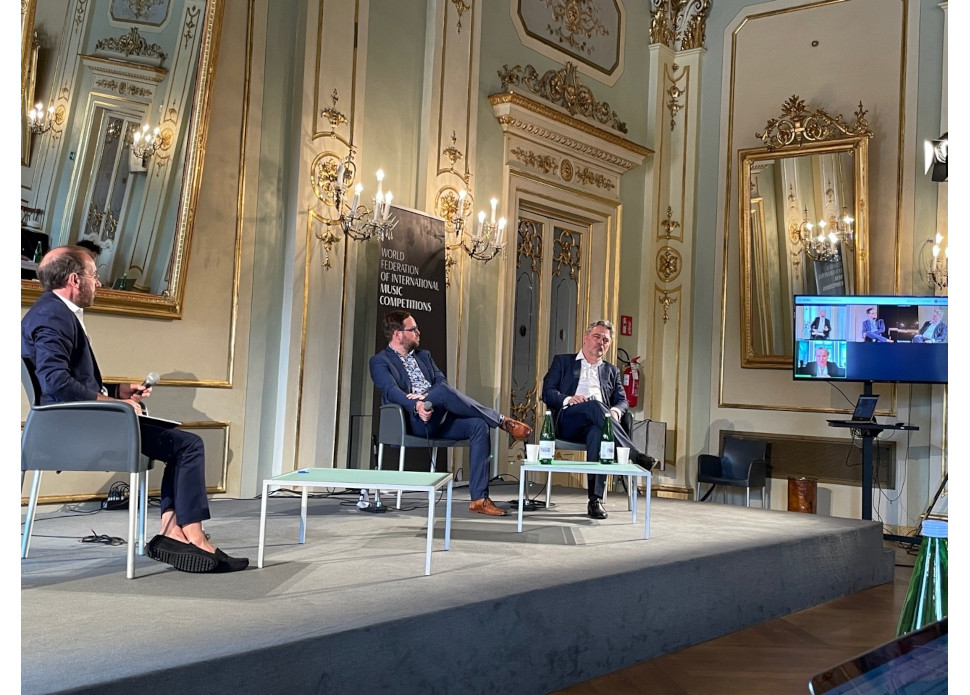
Emmanuel Hondré (Philharmonie, Paris), Rob Hilberink (Liszt Utrecht) and Peter-Paul Kainrath (Busoni Competition, Bolzano, Italy) at the first hybrid General Assembly of the WFIMC in Reggio Emilia, Italy, June 2021
How does WFIMC fit into the music industry and what is its role in bridging young musicians into the professional music scene?
Our main role is communication – to promote and support young artists and their careers, and to set international standards that are recognised around the world. For example, winning a WFIMC competition is an important factor for admissions to a graduate school; to receive a scholarship; to apply for a teaching position; or even to get an exemption from the military.
How has the world of music competitions transformed since the pandemic hit?
During the pandemic, thousands of performance opportunities were lost, thus not only taking away artists´ income, it is also severely affecting the careers of young musicians. Today, Competitions are no longer just about winning an amount of money (even this can be quite considerable in some cases). Many competitions now offer recordings, tours, agency contracts and marketing support- factors that are far more important for career development.
Besides these fundamental issues, Covid has forced most of us to adjust, to reduce physical presence and to cut travel. While quite a few competitions have now been held entirely online, many others have extended the digital part to cover one or more rounds. Almost all our competitions are live streamed, and quite often, some jurors do not attend in person, either.
Take this year´s Chopin Competition in Warsaw, for example: all the rounds have been sold out since last year, even more so because the halls cannot be filled to full capacity due to the pandemic.
Instead, the competition is live-streamed in virtual reality.
I am sure the Federation has seen many talented young musicians blossom into international renowned artists, what do you think were some of the common characteristics in these success stories?
“Competitions are for horses” is what Hungarian composer Bela Bartok once said, and in some way that is true; competitions can be gruesome and depressing. They take a long time to prepare, they cost a lot of energy. But if you look at it differently, competitions can also bring an incredible momentum – not only for your career, but also for your personality. To perform at an international competition is also learning about yourself: how far you can go, how well you can control yourself, how far you can grow above yourself. Maybe you have prepared a whole year to perform at a competition: it might have been a hardship beyond belief. But it can also be a mental process that will give you incredible strength and persistence for your life.
What do you think is necessary to enable and support equal opportunities amongst young musicians worldwide looking to start their professional careers?
We are working hard to bring the lesser-known competitions and their winners into the spotlight, promoting them and trying to create a larger audience for them.
When you leave out the relatively few on the top, young artists cannot survive anymore with an aging hometown live audience. They need to build and constantly take care of their own online audience as well – with social media, with recordings, live streams, interviews, masterclasses etc. This can be very hard at the beginning, but it also enables them to create an audience in places they would otherwise never visit.
What one-liner advice would WFCIM give to young budding musicians?
Never give up! Or, with the words of Winston Churchill: “success is not final, failure is not fatal: it is the courage to continue that counts!”
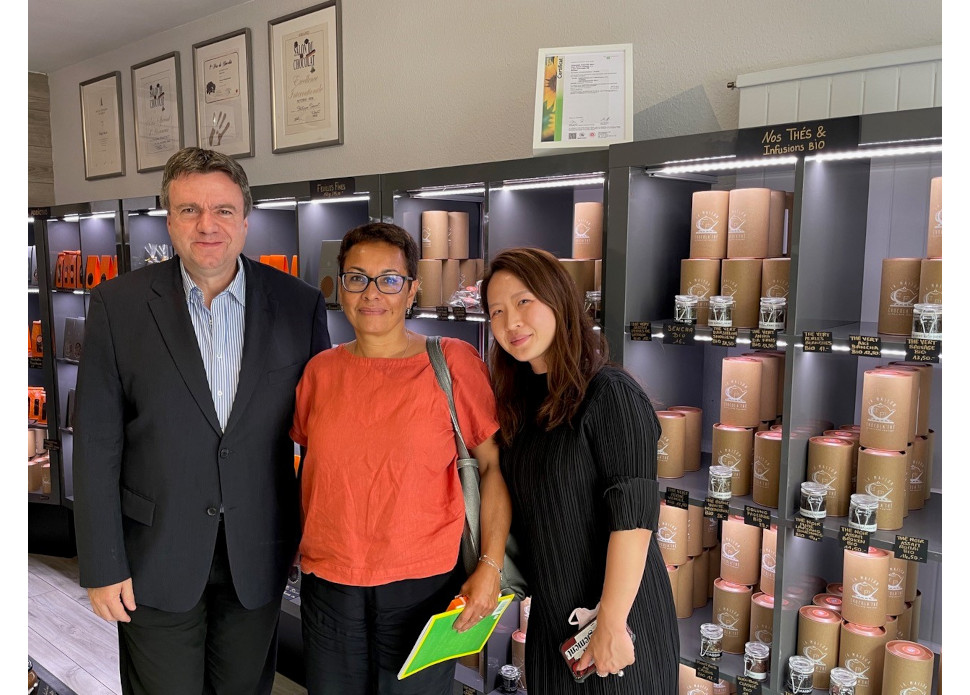
Florian Riem, Secretary General; Sarah Betrisey, Executive Assistant; and Jinyoung Kim, Manager/Marketing, in one of Geneva’s better Chocolate Shops.