
Composer Joe Chindamo unveils his new composition Ligeia for Trombone & Orchestra at ASO’s Symphony Series 2: Affirmation
Joe Chindamo is a musical polyglot in the tradition of Bernstein and Previn, who cannot be easily characterised. Routinely described as one of the best jazz pianists in the world for many years, his art has always transcended jazz.
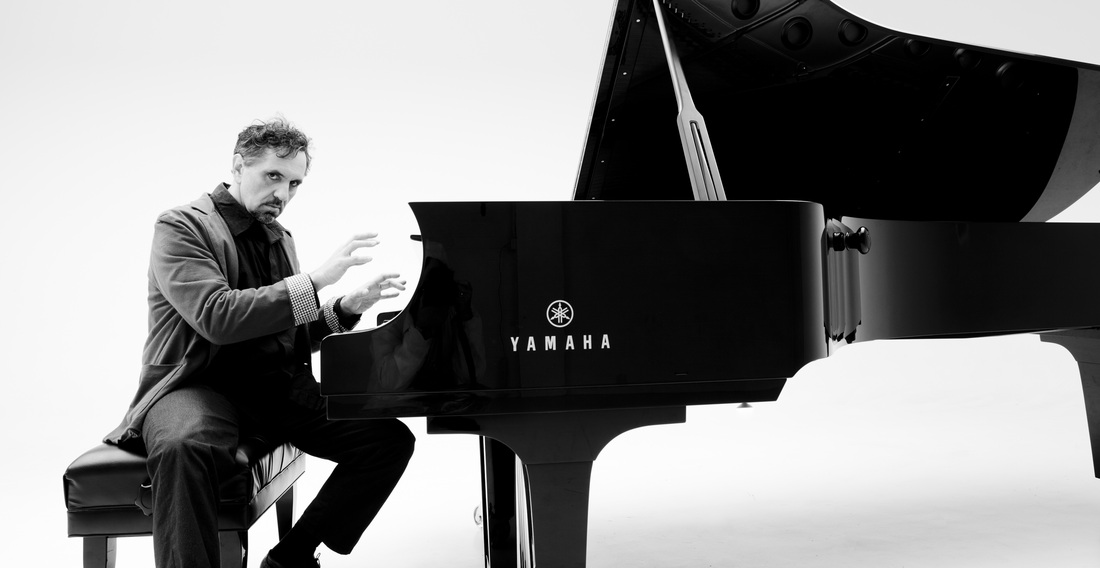
Joe Chindamo (Image Courtesy of Adelaide Symphony Orchestra)
Beginning his musical journey on accordion at six, he switched to piano at 15 and taught himself jazz piano by listening to and emulating the greats. At 18, he attended Melbourne State College (now Melbourne University), where he received his first official piano lesson, and majored in music and mathematics. At 21, he became the preferred pianist of film composers such as Brian May and Bruce Smeaton, and consequently provided the piano work for over 60 films throughout the next decade.
During this period, he also performed with a plethora of artists ranging from Shirley Bassey, Olivia Newton John, Dame Kiri Te Kanawa to Vince Jones. Returning to jazz predominantly at 30, he produced more than 25 recordings under his name, many of these winning awards, including reaching number one on the Japanese charts. He also toured the world with American legendary drummer Billy Cobham for many years and recorded with some of the world’s finest jazz musicians, such as Michael and Randy Brecker, Ray Brown, Ernie Watts, Larry Coryell, and Lee Konitz. In recognition of his remarkable contribution to this art form he was inducted into the Hall of Fame at the Bell Awards in 2016.
He has gradually moved away from jazz in recent years and increasingly concentrated his efforts on composition. As a result, he has emerged as a unique, daring and formidable new voice as a contemporary classical composer.
Section Principal Trombone Colin Prichard will perform the World Premiere performance of Chindamo’s commission for the ASO Ligeia at Symphony Series 2: Affirmation, 13 & 14 May 2022, Adelaide Town Hall.
Q & A with Joe Chindamo
You’ve been described as a musical polyglot, how do you describe yourself?
I suppose that characterisation stems from the fact that, relatively speaking, I’ve covered a lot of ground musically. For me, it all came from the same creative hub though, so it never felt that my focus was spread over a wide spectrum. I think the things that interest me are common to all great music.
Reinvention is the key to staying fresh and excited – I am not the same musician I was 5 years ago.
Also, I’ve always striven to find my own voice, and not be beholden to idiomatic dogmas. If I hear something that I think will work at a particular moment, I’ll explore that avenue.
In this sense, especially at this point of my journey, I would perhaps describe myself as a polystylist, a term coined by Alfred Schnittke, rather than a polyglot.
What sparked your love affair with music?
There was never a Big Bang moment for me and I honestly cannot remember a time when I wasn’t a musician. I can’t imagine what it’s like not to be so involved with music.
What drew you to classical composition?
From the moment I sat in the audience and heard a few bars of one of my first forays into writing concert music, I experienced a catharsis of almost religious proportions – it was life changing because in that instant, I realised that this is what I’d been searching for all my life: this is where I’m meant to be!
In some ways it horrified me because it made me wonder whether I’d wasted too many years playing jazz or doing other things etc.
But then realised that all these musical experiences have led to this point as an artist and perhaps even enabled me to bring something fresh to the table.
So maybe, the real answer to that question is – I’ve always been a classical composer but never realised it, and didn’t get around to writing my first composition for a good while.
You have had an illustrious career having recorded and performed with some of the world’s finest musicians, describe what you believe has been your greatest achievement?
You’re right, I’ve had many wonderful experiences making music with some of the most exalted musicians in the world. Touring with Billy Cobham was wonderful, as was making a record with Ray Brown (of Oscar Peterson trio fame). Having Michael and Randy Brecker play on my first album was very special too.
More recently, I’ve been working in a duo with violinist Zoe Black, which I still regard as a highlight, every time we perform. We played at the Weil Hall (Carnegie Hall) in 2015, which was certainly an important milestone for both of us.
In terms of writing achievements, the Concerto of Orchestra, commissioned by and premiered by the TSO last November, and Ligeia for ASO represent the pinnacle.
You are an accomplished studio pianist having worked on more than 60 film soundtracks, including Babe, The Man From Snowy River II, A Cry in the Dark, Warlock, Missing in Action II. Hotel Sorrento and The Sound of One Hand Clapping. Are you working on any new film soundtracks?
That’s all in the past – a distant dream. It was something I did mainly through my 20s and early 30s. It was very rewarding at the time, but then I started touring with American drummer Billy Cobham’s band, who kind of “discovered “ me and that was that – I toured all over the world with him for the next 10 years, playing with so many amazing musicians.
Film hasn’t been on my radar since, but if the right project came along – as a composer! – I’d get excited about it.
Tell us about Ligeia? What inspired you to write the new work for trombone and orchestra and what can audiences expect to hear?
Ligeia - Concerto for Trombone and Orchestra channels the world of Edgar Allen Poe – hence the title – and deals with the nature of duality, or the double, a recurring theme in the writer’s Gothic tales of mystery and the macabre.
It also ties in with Carl Jung’s idea that one wears a mask to convince themselves and others that they are not an altogether bad person, which is the central theme in Poe’s “ The tell-tale heart”.
As Jung explained, one cannot go beyond the persona – or the mask - until they have incorporated into their character those darker traits which belong to what he called the “shadow self”.
The work itself, in three movements, is highly energetic, – even quite wild at times – and virtuosic, for the orchestra and soloist alike. But then all of a sudden – in the midst of the frenetic and majestic ride, we find ourselves alone in a dark alley – confronted by our shivering shadow selves.
Throughout, there are quasi-operatic passages, full of drama, tempered by an eerie tender lyricism – as exemplified in the recurring Ligeia waltz (which first appears in the 2nd movement).
The trombone is the perfect narrator for such themes. It was a long standing Austrian/ German/ Catholic tradition to use the instrument in settings of Requiem mass and composers such as Mozart invoked it as a portent of death.
In this work however, the trombone’s bandwidth extends well beyond the funereal. Here it represents the hero, the court jester, the satirist, the sage, the wizard, the prince, the pauper, the poet, the wit, the lover, the romantic: one by one, entangled in a symbiotic waltz with “the shadow”.
Have you spoken to ASO soloist Colin Prichard who takes on the responsibility for bringing Ligeia to life?
I’ve had many conversations with Colin, who taught me so much about his instrument. With someone of his ability, you soon realise that standard references are not very useful, since he can play well beyond the standard range and can accomplish feats that would frighten most trombonists. As a composer, I needed to discover what his parameters were, rather than those of the instrument. Our initial talks were essentially about finding a common ground, so I could create a piece that was as much his as mine. Our common ground turned out to be incredibly fertile and I was delighted to discover that we shared many musical values. In addition to our meetings, I studied his playing by way of YouTube clips that feature him and tried to capture his personality and character.
Tell us about the composition process?
The work took me just over three months to compose. That’s three half months of obsessive writing with nothing else in my life getting in the way – almost - I had to take a week off to complete another commission. But day and night, I thought of nothing else.
I had to establish the narrative, which is where Edgar Allen Poe came in. As I always do, I endeavoured to enter a state of mind where it feels as though the work could write itself.
The practicalities of writing are not so different to the procedures of other composers. Sitting at the piano, improvising, dreaming up melodies, scribbling notes on sheets of paper, using music notation, recording ideas with sampled instruments, throwing away a whole day’s writing and resetting, having meetings with the soloist and listening to a ton of orchestral music.
Most of all, whenever I’m writing my antenna is switched on and someone would say something to me that seems flippant and unrelated, but it might have such a profound effect that it will affect the course of the piece.
I must say, I hit the ground running on this one because I had just completed a Concerto for Orchestra for TSO, so my compositional nerve endings were already heightened. When I started working on this piece, I didn’t have to muster any adrenaline, which is my composing ally. Then once the basic structure was established, I orchestrated and re-orchestrated and re-orchestrated as the deadline – always my friend – loomed.
Will we find you in the audience for the World Premiere performance?
Yes absolutely!
And if so what are your expectations?
To smile a lot, be moved, be impressed, be emotional, be excited, and generally have a wonderful time.
Are there any plans for Ligeia to be performed elsewhere?
No specific plans because it’s still early days, Of course, it’s my hope that Ligeia will be welcomed into the trombone & orchestra repertoire and have a life beyond the premiere.