
Up Close & Personal with Yvonne Tham
An Interview with Ms Yvonne Tham
Chief Executive Officer, The Esplanade Co Ltd, Singapore
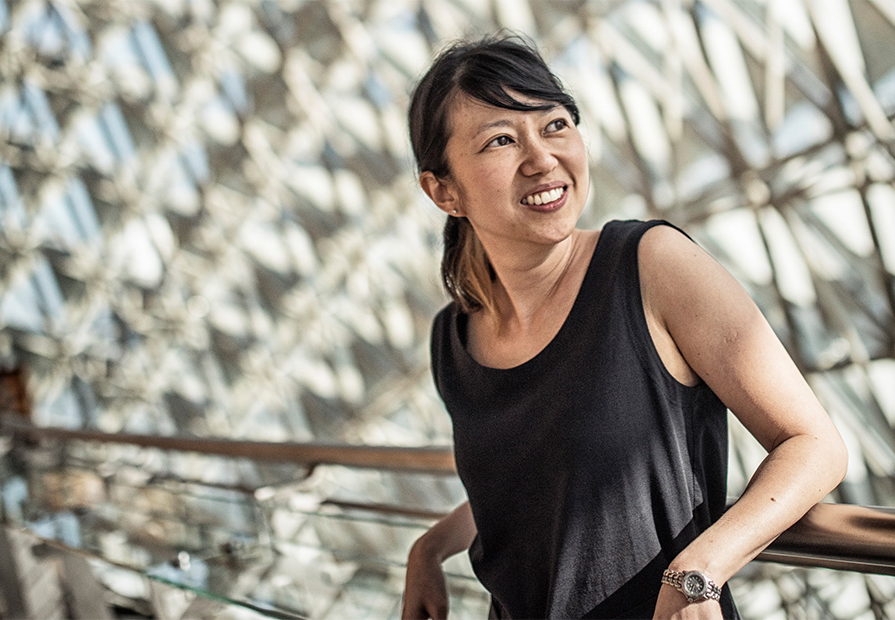
Esplanade CEO Yvonne Tham (Photo credit: Bryan van der Beek)
- Being the new Chief Executive of Esplanade, we understand that the mission and vision for the centre remains – To be the art centre for everyone. To entertain, engage, educate and inspire.
Please share with us some of your aspirations and goals in the next few years.
Esplanade’s vision, from the time we opened in 2002, is to be a centre for everyone. This does not change because there’s still so much more we can do to fulfil that vision, especially in today’s world where societies are more divided. In fact, the role of a performing arts centre as a common civic and cultural space for everyone is even more urgent today, where the arts can bring greater knowledge and understanding of different cultures and needs, and bring communities together.
We started on a journey a few years ago to be even more inclusive, both as a physical space and through our programmes. Over the next few years, we will create more programmes and access for the young, seniors and vulnerable communities. There will be greater focus on research to understand better the impact of the arts on our youth, aging and the many aspects of well-being, as well as building the capabilities of artists interested in these areas. I am also mindful that even with some two million attendances a year, there still remains many who have yet to step into Esplanade or to have the opportunity to encounter the arts here. The arts centre always has to build a relationship with each new generation, to shape and be shaped by them. Our goal is that every young person in Singapore will have the opportunity to encounter the arts at Esplanade by the age of 26, be it as an aspiring performer, a volunteer, or simply to enjoy, be challenged or inspired.
In our next phase, we know we cannot do this alone. While we’ve always created programmes for everyone, we are stretching ourselves now to be an arts centre that is embraced by everyone. Many Singaporeans have given us the nickname “The Durian” from the coincidental resemblance of the cladding on our twin domes to the much-loved spiky tropical fruit. And so we’ve adopted the “MyDurian” tagline, tongue-in-cheek, as a reminder that our goal is for every Singaporean to feel a sense of ownership towards the arts centre. We’ve started to more actively involve our donors and sponsors, and a wider pool of audiences, advocates and volunteers, to be part of our mission – even if it’s a small way of giving towards a free programme, giving a shout-out to their friends about a programme, or spending a couple of hours volunteering with us.
A third priority for us is to move towards giving greater support to the making of new works, particularly by Singapore and artists in the region around us. And we want to do so in partnership with other producers, festivals and arts centres in the Asia Pacific. We feel it is the right time for Esplanade to do more to commission, produce and support original works that speak of who we are and where we come from.
Our new waterfront theatre, a mid-sized venue that fills a gap between our large theatres and small studios, will be the “game changer” in all these areas. We’ve waited many years for a mid-sized venue! This new venue will allow us to present a wider range of performances, and to support also the making of new works that hopefully can have resonance beyond Singapore. This new theatre has also inspired us to rethink the entire visitor experience along the waterfront and the connection with the Marina Bay and neighbouring Civic District precinct of museums. The construction is due to start soon in 2019, and we aim to open the theatre in the 1st half of 2021.
Another area that is hugely exciting will be the digitalisation efforts that we are putting in place, from marketing, visitor experience, audience outreach and engagement, to our internal processes. We’ve started to digitise our archive of performance recordings, create online content that can complement a pre- or post-performance experience, and to work towards a mobile-enabled experience of the arts centre. What will a digital performing arts centre look like and what good can it do for our society? That’s what we’ve set ourselves to imagine and to create.
- What would you say are the main challenges facing Esplanade today?
On Programming and staying ahead
We have always challenged ourselves to continuously enrich the lives of our people in Singapore through the breadth and depth of what happens at the centre. Many of our festivals are now in their 10th or even 17th year. So a key challenge is definitely the balance between the long-term investments in artistic and cultural development we must make as an arts centre, and the need to constantly refresh our festivals, programmes, the holistic experience when someone visits the centre, and how we communicate and engage with people, on their platforms and relevant to their lives.
On Funding, Sponsorships and Donations
There are still many misconceptions when it comes to giving to the arts but perhaps the biggest of all is that it is only the government’s duty to fully support the arts!
While Esplanade receives grants from its parent Ministry, Ministry of Culture, Community and Youth (MCCY) and Singapore Totalisator Board (Tote Board) to supplement its earned income, there is also the expectation that we should be increasingly less reliant on government support in meeting our recurrent funding needs, not only through our earned income, but through sponsorships and donations towards our programmes.
One challenge is doing better in engaging people who care and want to support our mission, but also reaching new sponsors and donors, and better articulating the impact of our work and the impact their sponsorship or giving makes. With the new waterfront theatre, for example, we set ourselves a goal of raising $20M for the entire development which we expect to cost $30M. The Singapore Government has given us $10M and we recently announced the generous donation of $10M from Singtel, so we still have some way to go!
On staying efficient and keeping standards high
Since we officially opened in October 2002, the centre has presented more than 41,000 performances, drawing an audience of 28 million, and 96 million visitors. This intensity of use far exceeds even the most optimistic projections when Esplanade was first conceived. One challenge, even as we continue to improve the property, is how do we be a lot more energy efficient and green, from the use of LED to reducing waste and consumption when we produce and in our marketing and venue operations. A second challenge in labour-tight Singapore, is how can we work smarter and make jobs at the Esplanade – be it front or back of house positions – more productive and meaningful with the help of technology and skills training.
On succession and people
I know I have just started on the CEO job, but succession is constantly on my mind! It is not so much about succession for any one specific position, but the broader challenge of motivating and developing a next generation of programmers and leaders for the arts centre and the arts scene in Singapore. We need good people from diverse backgrounds who have not only the skills but also the heart, who care to stay and acquire a deep understanding and appreciation for the life of an arts centre, as well as the relationships and networks in this sector. It always boils down to motivated people and leadership.

Esplanade CEO Yvonne Tham (Photo credit: Wesley Loh)
- Esplanade is building a new mid-sized theatre. When will this theatre be completed and how would it change the arts centre’s programming direction?
With our new waterfront theatre that’s opening in 2021, Esplanade will be able to:
Develop and present a wider range of programmes for schools
There is opportunity for Esplanade to expand on its programmes for the young, working closely with artists and arts groups. As our smaller studios are already fully utilised, the medium-sized theatre will provide an additional platform for such programmes that provides for a closer interaction with the arts.
Better support the development of Singapore’s promising community, youth and traditional arts groups, especially in theatre and dance
Today, the development path for many of these groups starts from Esplanade’s non-ticketed platforms to ticketed presentations at our small venues. Many have done well and are ready to take on a larger platform to reach an even wider audience. However, to make the transition from a small venue to Esplanade’s 2,000-seat Theatre is often too big a step to take for these groups, and will require a lot more resources. Moreover, many traditional Asian art forms are better suited to a more intimate setting. The new 550-seat waterfront theatre will more aptly meet the needs of these groups.
Work closely with both Singapore and regional artists to create new content, with touring potential, particularly in Asian traditional arts and contemporary theatre and dance
Through our various cultural festivals, and platforms such as The Studios and da:ns festival, Esplanade has embarked on supporting, commissioning, or directly producing new works with both Singapore and regional artists in its smaller 220seat Theatre Studio and 245seat Recital Studio. Many of these new works have been well-received by audiences in Singapore, and some have even gone on to be performed overseas. There is a need to push artistic boundaries, to scale up these works, as well as continue to create new productions through a 550-seat venue for greater impact and reach. Esplanade can also leverage on the strong international networks that it has built up to promote Singapore works to overseas festivals looking to receive works for their mainly medium-sized venues.
Present medium-sized works, which are a majority of all works produced today internationally for major festivals
A majority of new works created regionally and internationally for major festivals are made for medium-sized venues. This will allow Esplanade to programme a greater variety of works and experiences for audiences – a presentation of medium-sized works amidst the existing large-scale and smaller studio-type works.
The new theatre makes possible a rethink of some of our existing festivals, programmes and formats. Details on what will be presented at our new waterfront theatre will be announced in due course. Watch this space!
- Is there anything that has surprised you about Esplanade since you took over the baton officially?
I’ve been at Esplanade for slightly more than four years before I took on this role. So I’ve had my fair share of surprises and lessons over the last four years already – and I’m quite sure the lessons will continue.
- Tell us a little about yourself – what were you doing before this and how did you come to be involved in the arts?
The arts has always been a part of my life. I was a literature student in university, I draw and I’m married to a designer, so the literary, art and design world is something I am close to. In my teenage years, I became a huge art film buff – and I still count the Singapore International Film Festival as the first “arts” festival I’ve fallen in love with, and I continue to be involved with the Singapore Film Commission. In fact, the performing arts is something that I’ve become more immersed in only when I started work.
Prior to joining Esplanade in June 2014, I was with the National Arts Council for four years as the Deputy CEO. My time there also overlapped with Benson’s stint as the CEO of the Arts Council. I spent almost 10 years in the Singapore civil service, with the Arts and Heritage Division at the then-Ministry of Information, Communications and the Arts (now Ministry of Culture, Community and Youth). There, I was involved in setting up the School of the Arts (a pre-tertiary school for the arts), the Design Singapore Council, and the National Gallery. The other government department I spent a couple of years in was the Ministry of Manpower. My first job was teaching literature to 17, 18-year-olds
- Tell us one thing interesting that most of your colleagues do not know about you?
Many arts administrators probably have (failed/unfulfilled) dreams of being an artist. Every year, I try to complete some kind of art and design project, sometimes working with other creatives. Last year, my husband James and I published a comic book. Thankfully, I have no aspirations to sing, dance or act.
- Who has had the greatest influence in your life and why?
It would probably be my husband James, just because we have no kids and spend most of our time outside of work together!
- What do you like the most about yourself? And what would you change about yourself if you could?
I would like to be a lot more disciplined about exercise…
Visit Esplanade – Theatres on the Bay’s website here.