
A Reflection On The Importance of International Touring
By Simon Lord; Director, Artistic Planning, Adelaide SO/04 November 2019
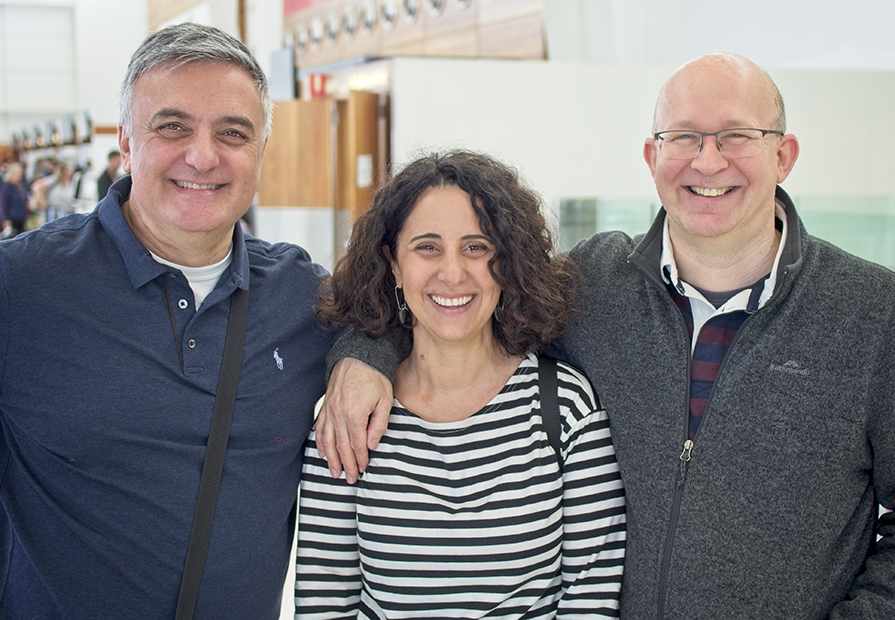
Managing Director, Vincent Ciccarello; Director Special Projects International, Paola Niscioli; and Director Artistic Planning, Simon Lord (Photo credit: Lachlan Bramble)
‘Scale a thousand mountains and cross ten thousand rivers….’ (Chinese Proverb)
Last week, the Adelaide Symphony Orchestra and our Principal Artistic Partner, the violinist and conductor Pinchas Zukerman, returned home after a two-week tour to China and South Korea. Since we have gotten back, many of us at the ASO have been reflecting on what it takes to tour a symphony orchestra internationally. Where lay the challenges and what are the benefits?
Touring a symphony orchestra of over 70 musicians is an expensive undertaking and, logistically, a complex business. This trip was no exception and it was several years in the making. The initial spark of an idea came from conversations in 2017 at a conference in Guangzhou hosted by the Association of Asia Pacific Performing Arts Centres which the ASO’s Managing Director, Vincent Ciccarello attended. Not having toured internationally for over a decade, we jumped at concert invitations from the Beijing Music Festival and the Tongyeong Concert Hall in South Korea. And so began the long discourse with colleagues, at home and overseas, about dates, artists, repertoire, contracts and logistics. Things began to fall into place. Pinchas Zukerman’s absurdly busy diary had a window of opportunity which aligned with our potential concert date in Beijing. It was all a bit tight, but Zukerman could join the orchestra in China for one day of rehearsal and the concert schedule would work. Then, with the expert help of our tour promoter, Liu Kotow International Management, other concerts came into the diary for Zhuhai and Shanghai. And then were the many ups and downs. For my boss and Development team colleagues here at the ASO, seeking to raise the significant funds for this trip was a huge, and at times, seemingly impossible, mountain to scale. Some weeks the tour was on, some weeks it was off. But climb the mountain we did, and, with support from the Government of South Australia, BHP and the generosity of several private donors, we were suddenly boarding the plane for the eight hour flight to Guangzhou.
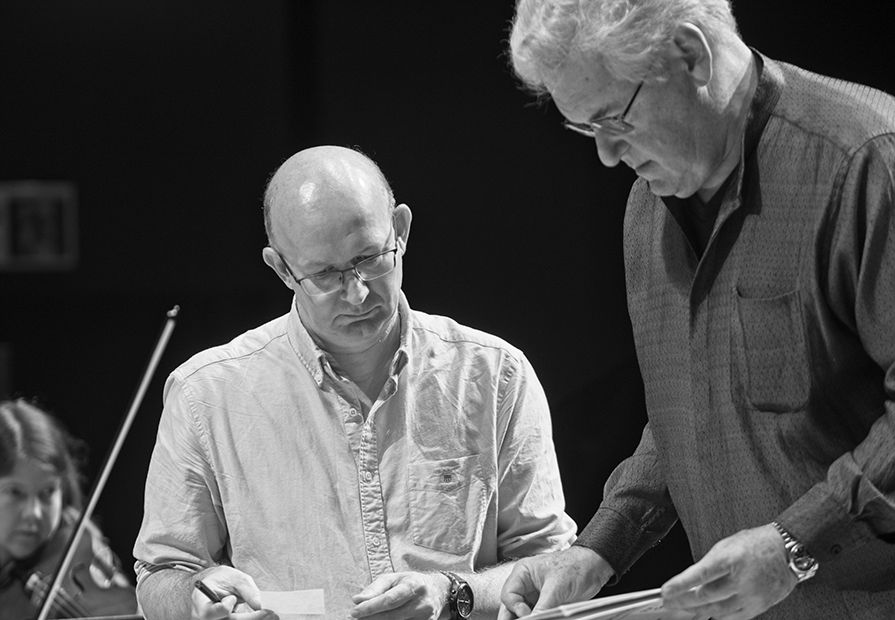
Simon Lord helping Maestro Zukerman with some last minute adjustments to the score in Tongyeong, South Korea (Photo credit: Lachlan Bramble)
The musical benefits resulting from orchestral touring are many and various. Normally, for financial and practical reasons, most professional symphony orchestras’ schedules are limited to two or three performances per week. This allows little time for true immersion in the music. However, including the concerts in Adelaide last week, our musicians and Pinchas Zukerman performed the same repertoire eight times over a two week period. Through repeated performances in different concert venues, for different audiences, in different time zones, in sunshine or in rain, the ASO’s reading of Elgar’s Enigma Variations deepened immeasurably. This may be music which many performers and listeners regard as familiar, but orchestral touring breathes new life and fresh meaning into old friendships. Also, over the last two weeks, the ASO played in unfamiliar concert halls ranging from the good to the great. The hall is the orchestra’s instrument. Performing in different spaces presents new challenges as musicians’ listening skills are honed and performance strategies refined. Sonically, the orchestra matures.
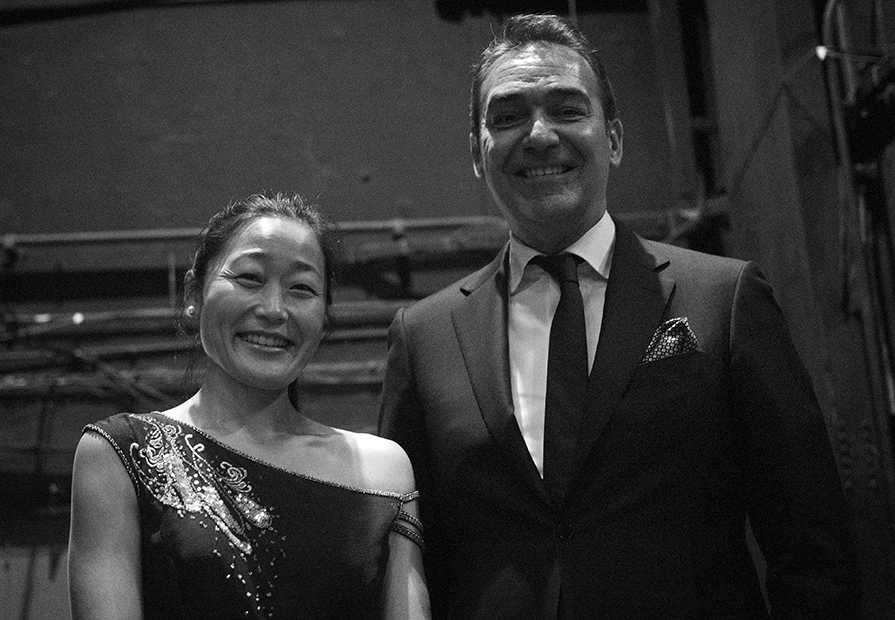
Concertmaster Natsuko Yoshimoto backstage with Premier Steven Marshall at the sensational Shanghai Symphony Hall (Photo credit: Lachlan Bramble)
Shanghai’s Symphony Hall is one of the great concert halls of the world. It was built in 2014, has 1,200 seats and is home to the Shanghai Symphony Orchestra. The room is an intimate, exquisite space which boasts exemplary acoustics combining clarity, warmth and depth. Whilst the strong dynamic passages in the Finale of Enigma never sounded forced, the real revelation was in the pianissimos which uncovered previously unheard details. For the ASO’s third encore of the night our strings played the Larghetto from Elgar’s Serenade which ended in golden silence. As Pinchas Zukerman commented after the concert, many orchestral musicians never have the opportunity to experience such musical alchemy. This was a rare privilege.
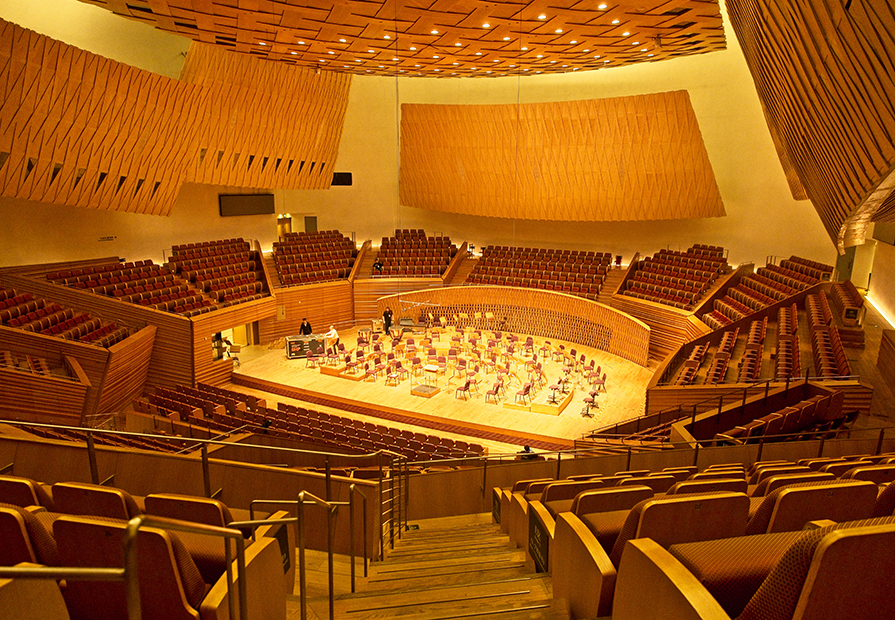
‘Like playing inside a Stradivarius’ – Symphony Hall in Shanghai (Photo credit: Lachlan Bramble)
And what benefits are there to be reaped off the concert platform? In these times of uneasy global politics, cultural diplomacy is increasingly valuable in cultivating people-to-people connections. It may well be a cliché, but music is a universal language. In September, just before the ASO arrived in South Korea, the Chinese-American cellist Yo Yo Ma played J.S. Bach’s solo Cello Suites in the country’s demilitarised zone at Paju, Gyeonggi Province near the North Korean border. Yo Yo Ma proclaims that music can ‘build bridges, not walls.’
Performing music on the world stage away from home does build international bridges, but it also builds bridges within the orchestra. It develops an ensemble’s personality and builds its confidence. In Beijing, the ASO shared the platform with the virtuosic Gustav Mahler Chamber Orchestra and, in Shanghai, we rubbed shoulders with the Deutsches Symphonie-Orchester Berlin. In such celebrated company, the ASO presented itself not only as a formidable ensemble but also as a powerful advocate for our state and country.
And there is an intrinsic social value. Taken out of its comfort zone, the whole ASO team embraced this adventure together. Whether it was scaling the Great Wall of China, rejoicing in the sublime beauty of Mozart and Elgar in Shanghai, or sharing a late night post-concert banquet of challenging crustacean delights in Beijing, these were formative, memorable times. Of course, even with the best laid plans, stuff happened: passports were mislaid, travel fatigue set in and one tricky outdoor performance venue presented some unwelcome surprises. However, with mutual understanding, flexibility and a bit of humour, the show went on and our tour went off. It is hard to attach a metrical value to the manifold social, cultural and political benefits of the ASO’s trip to China and Korea, but its artistic legacy will be lasting as, ultimately, we will hear it in the music-making for years to come.
Click here to visit Adelaide Symphony Orchestra’s website.