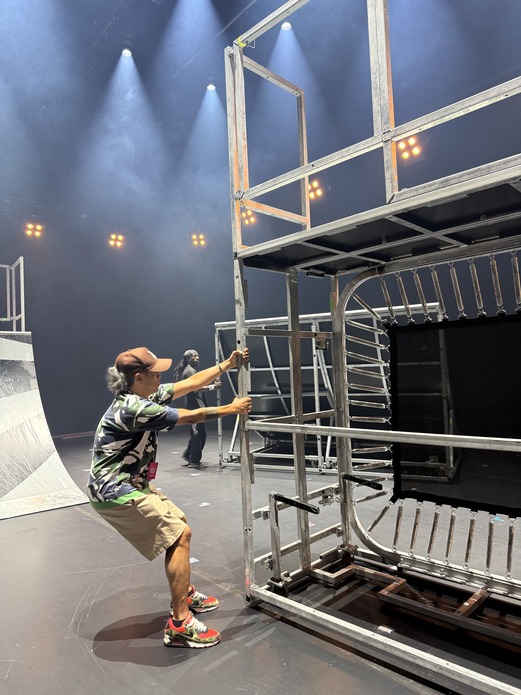
Up Close & Personal with Marco Gerris (ISH Dance Collective)
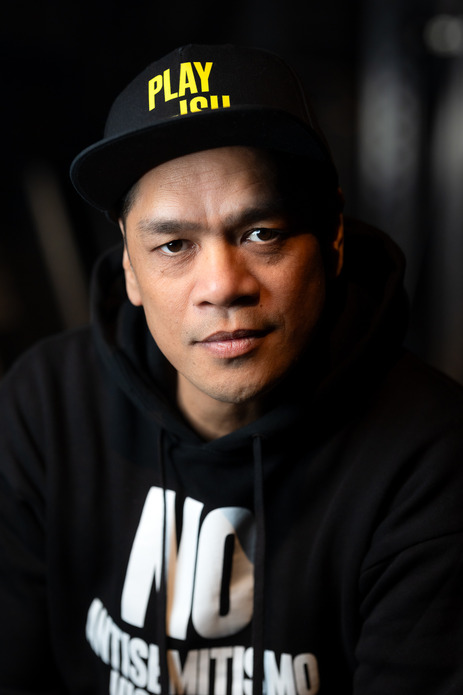
Marco Gerris (Photo credit: Michel Schnater)
Share with us the core philosophy that drives ISH Dance Collective’s work.
The core philosophy of ISH is ‘bringing the streets to the theatre’. We are a hip-hop dance company, which in other countries is sometimes referred to as ‘street dance’ or ‘urban dance’. We are inspired by the urban landscape and its many possibilities for creative exploration: for breakers, a piece of carton can be a dancefloor, for a parkour athlete a wall is not an obstacle but a step up, for a street footballer, a square in the city can become an arena, for a skater, a bench is not something to sit on but an object to test his skills. We bring that same mindset to theatre and with our athletes and dancers we explore new ways to bring the various disciplines together in a theatrical setting and redefine choreography along the way.
You often work with artists from diverse backgrounds and disciplines. How do you foster an environment that encourages artistic exchange and collaboration?
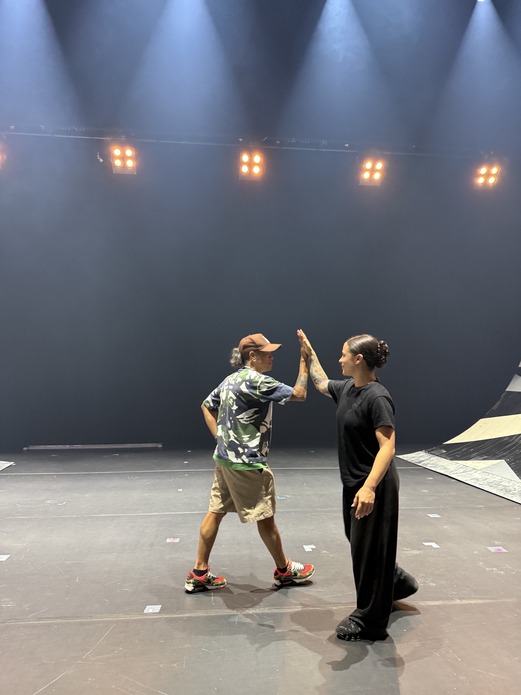
Our work is inspired by the ‘each one, teach one’ principle, as practised in hip-hop. This means that my performers are constantly both teaching and learning from each other, never just focusing on their own discipline. It is key for me to select performers not just based on their skill, but also on their willingness to engage with others and try new things. In the creative process, I offer performers the platform to show off their skills, but I also challenge them to do things they have never done before. I set the framework for the process and direct them along the journey, but a lot of interaction and creation also happens between the performers. This creates a lot of respect between them and builds trust to come up with really unique and creative ideas.
One of your key missions is to bring hip hop dance and urban sports/street arts into the theatre. Tell us about the challenges you face in doing so, and how you managed to overcome them.
ISH was founded in 2000 and we’ve just celebrated our 25th anniversary. For a long time, the Dutch dance world did not take ISH seriously at all. Even though I clearly worked with highly talented dancers and performers, most critics, funding bodies and other choreographers did not consider our shows as ‘dance’. What they couldn’t deny, however, was that our shows filled venues with enthusiastic young people – something most traditional dance companies never achieved. So, we simply kept going! Over the years, the image of our company changed, probably also because about a decade ago I had started to collaborate with ballet companies, orchestras and theatre companies actively. We got accepted into the system gradually, and we’re also celebrated for the innovation we bring, both artistically as well as in terms of audience. I started to receive all the major awards in the Netherlands over the last five years, so it seems hip-hop has finally been accepted as an equal dance form to modern dance and ballet. I’m so proud that in the slipstream of our company’s advances, several new generations of Dutch hip-hop choreographers have also found their way into the funding system and theatres, and are benefiting from my battles of the past.
What kinds of opportunities is ISH looking for to expand its reach and impact, both locally and internationally?
In the Netherlands, a large part of our activities now focuses on new generations: we have started the ISH Academy for children and young people, we support 10-15 emerging and mid-career choreographers each year through our ISH Talent programme, and we create opportunities for the community to train, present and develop through our ISH Community programmes. Internationally, we tour a lot and find that everywhere around the world our shows manage to bring young audiences into the venues and help shape a new idea of what dance performances can look like. I’m personally also very excited by a project that we’re working on with WestK in Hong Kong, a new show that brings together performers from the local underground and club scenes with performers from the major performing arts companies – exactly what I’ve been doing all my life in the Netherlands, but now suddenly in an entirely different country and culture. Very inspiring!
What is the favourite part of your job?
Being in the studio, working with performers on a new show will always be the favourite part of my job. But sitting in the theatre and seeing the audience go wild is a close second best! I feel grateful to have been working with such a wide range of talented individuals throughout my career, I have worked with the world’s best in all the various hip-hop dance styles, urban sports, classical music, ballet, theatre and many more disciplines and subdisciplines – it is truly a privilege. Touring the past few years to all these different countries, learning about local cultures, meeting audiences and performers from around the world, has definitely also brought a new perspective and a new joy to my life as an artist. I just have the best job in the world!